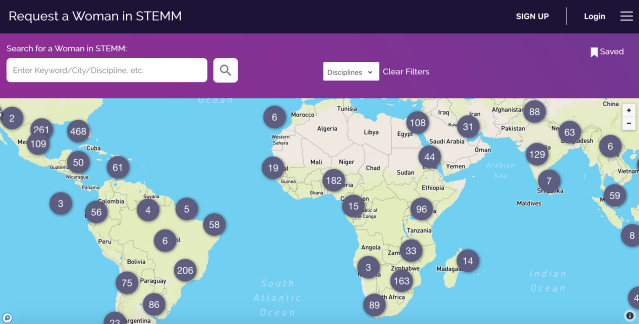
 500 Women Scientists is excited to announce the launch of its new and improved “Request a woman in STEMM*” platform. Based on feedback from users and database members, the new database sports an improved UI experience, individualized profiles, and improved capabilities. Developer Critigen has designed and implemented a much more accessible and usable platform that will help find women experts across scientific fields and change perceptions of what a scientist looks like.
500 Women Scientists’ central mission is to serve society by making science open, inclusive, and accessible through the transformative leadership of women in *science, technology, engineering, mathematics, and medicine (STEMM) fields. To meet that mission requires changing the face of what a scientist looks like. 500 Women Scientists has leveraged a network of over 300 Pods (or local chapters) around the world to increase representation of women in STEMM through a number of locally-driven initiatives.
Two years ago, 500 Women Scientists launched the “Request a Woman Scientist” platform. Tired of constantly seeing the same faces, mostly white men, representing science in the public sphere, the platform was developed to provide opportunities for members of the media, scientific colleagues, conference organizers, educators, and others to find and include more women and underrepresented identities. In the past two years, the platform has grown globally to include more than 12,000 individuals from over 140 countries and territories. The new and improved platform features more information about platform participants, individualized profiles, improved searchability, ability to save profiles, and many other updated features. As a part of the new platform, 500 Women Scientists hired Concolor Research to assess the platform’s reach and impact. With generous support from the Simon’s Foundation Science Sandbox and Lyda Hill Philanthropies, 500 Women Scientists worked with the development team Critigen to update and revamp the platform, making it more accessible. There is truly no excuse for not including women scientists’s voices in the public science discourse.
 Elizabeth McCullagh Lab