2025 recap

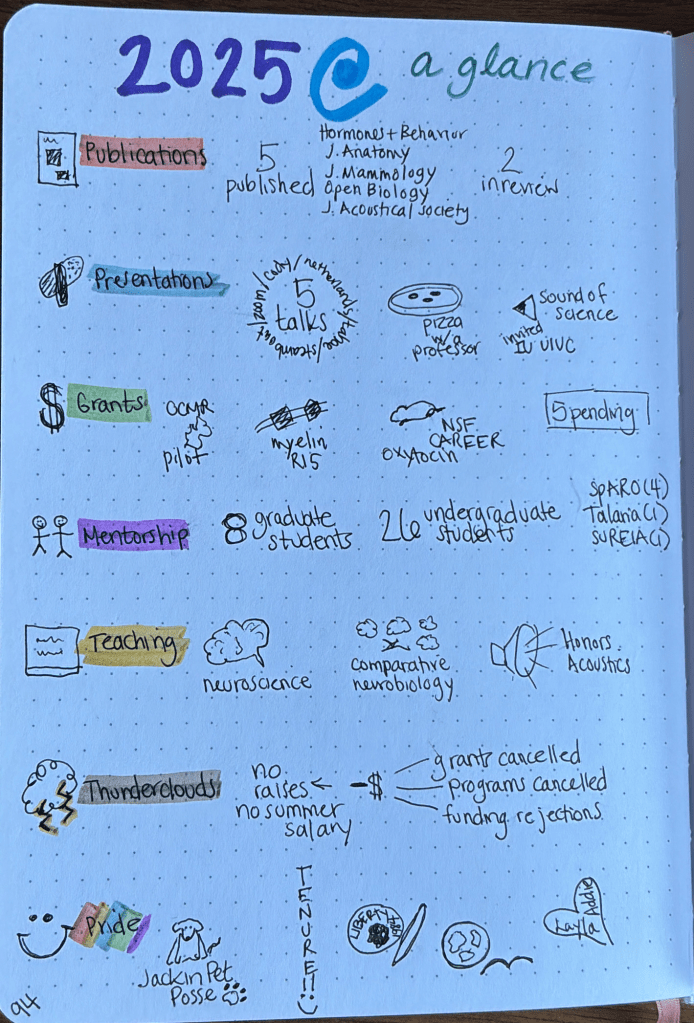
Wow, 2025 was a whirlwind of struggles, successes, and uncertainty. I wanted to take a moment to highlight some of the things that are more top of mind for me as we finish out this year and look forward to the next.

Publications:

While 2024 was a little light on getting things out of the lab, it wasn’t for a lack of trying, which reflected in 5! papers out of the lab in 2025.

PhD candidate Jesse Hurd published her first, first author article on her work on male prairie vole reproduction changes after pair-bonding 💜 : https://www.sciencedirect.com/science/article/pii/S0018506X25001059. This work also included contributions from collaborators Zoe Donaldson, Craig Miller, and Alexandra Ford as well as lab members Casey Sergott and Gracie Toben.

PhD candidate Luberson Joseph was super busy cranking out papers including characterizing the hearing across two closely-related Peromyscus species 🐁 https://pubs.aip.org/asa/jasa/article/157/6/4559/3350705 and sex differences in hearing 👂 in the hispid pocket mouse https://academic.oup.com/jmammal/article/106/5/1178/8240876. Importantly he also used our army of undergraduate researchers to include authorship for Sarah Hobbs, Nale Colon-Rivera, Tamara Woodley, Margaret New, and Vanessa Franco who have all helped collect wild rodents across the years.

Casey Sergott, newly PhD candidate, published her masters thesis work on using museum specimens of Peromyscus species to assess anatomical 📏 measurements of hearing https://onlinelibrary.wiley.com/doi/full/10.1111/joa.70011. Also included in contributing to this work from the lab are Luberson Joseph, Genesis Alarcon, and Katelynn Rodman.

Last but not least, collaborator Giulia Bertolin and student Claire Caron and I published our work that was funded through a small grant that allowed us to travel ✈️ to visit each other (FACE Foundation). We saw sex differences in a genetic form of autism, Fragile X Syndrome, specific to mitochondria 💥 in the auditory system that could underly differences in auditory processing.

These contributions to the scientific literature highlight the lab’s continued interest in comparative hearing approaches, interactions of hormones and physiology, and hearing in autism/Fragile X Syndrome.

Presentations

The lab traveled a lot this year to share our research, included invited talks in the Midwest (IU, UIUC) and contributing to conferences (Animal Behavior Society, ARO, WCBR, etc.) and we will continue this in 2026.

We also talked about our research locally including bringing the Sound of Science exhibit to a tailgate at OSU (more travel for the exhibit planned in 2026!, stay tuned) and coming to Kicker’s Unmasked show: https://www.youtube.com/watch?v=IxJj1IcDeuU and 🍕 Pizza with a Professor event for the Honor’s College.

Grants

We are extremely grateful for recent funding to come through to help continue to support the lab in our research including NSF CAREER award investigating oxytocin contribution to sound localization of socially relevant sounds 👋 https://www.nsf.gov/awardsearch/show-award?AWD_ID=2440070

We received a renewal of our NIH R15 award which allows us to continue our work on auditory processing in Fragile X Syndrome https://reporter.nih.gov/search/6RWqSFDFPk64pMwzSD0XpA/project-details/11125625

We received support from the OCMR https://cas.okstate.edu/microbiology_and_molecular_genetics/oklahoma_center_for_microbiome_research/ to explore microbiome alterations in Fragile X Syndrome.

This was also in the backdrop of extreme uncertainty in funding in the U.S. and non-award of a highly competitively scored NIH R01, termination of NIH-funded G-Rise which supported student Jesse Hurd as well as many other graduate students here at OSU, and termination of our postbac program ON-RaMP that supported Nale Colon-Rivera and previously supported PhD student Genesis Alarcon.

Mentorship / Shoutouts

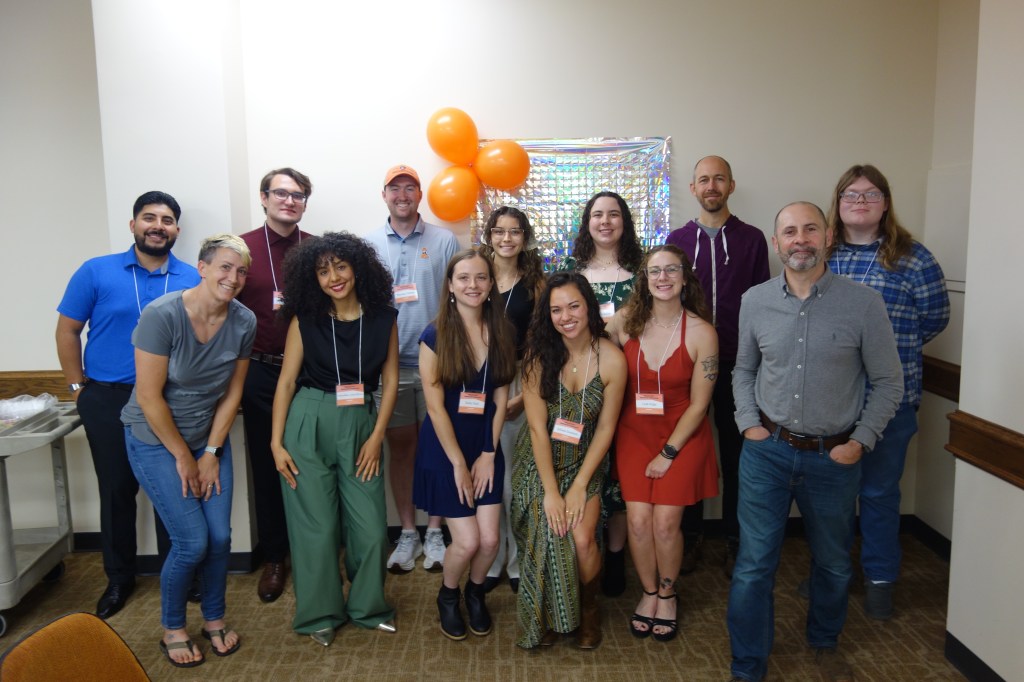
The lab now has 8 graduate students (7 PhD, 1 MS). We welcomed Mikayla Verdin as a MS student this Spring and Gen Alarcon switching from the MS to PhD program (woot academia!). We are hoping for a few graduations in Spring 2026, so if anyone is looking for postdocs, I know of some amazing people that would be great for your lab!

Undergrad Ashlee Munoz received a McNair scholarship!

Grant Emerson got into OU medical school!

Olivia Emerson received a poster award at the Karen Smith Symposium!

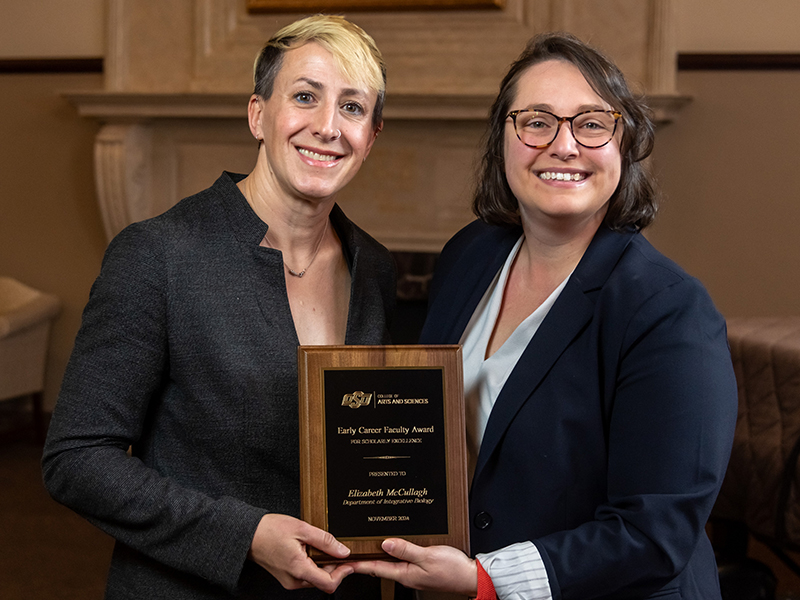
Liz received tenure this year and is now an Associate Professor as well as received the Distinguished Early Career Faculty Award from OSU.

Lucas Boren who was a recent addition to the lab in Fall 2024 graduated! He has been a great addition contributing to our anatomical studies of wild rodent brains. We are hoping he will continue to work in the lab after graduation while he prepares to apply for medical school.

Addison Browning graduated with Honors! Her project was testing audiogenic seizures (seizures that result from loud sound exposure) in our Fragile X Syndrome mouse models. Her Honors thesis was around this work and we are looking forward to her getting into medical school and becoming a doctor!

I’m sure I am missing some other important accolades, either way we are proud of everyone in the lab for their continued hard work.

Here’s to 2026 and continued work in science!!!!
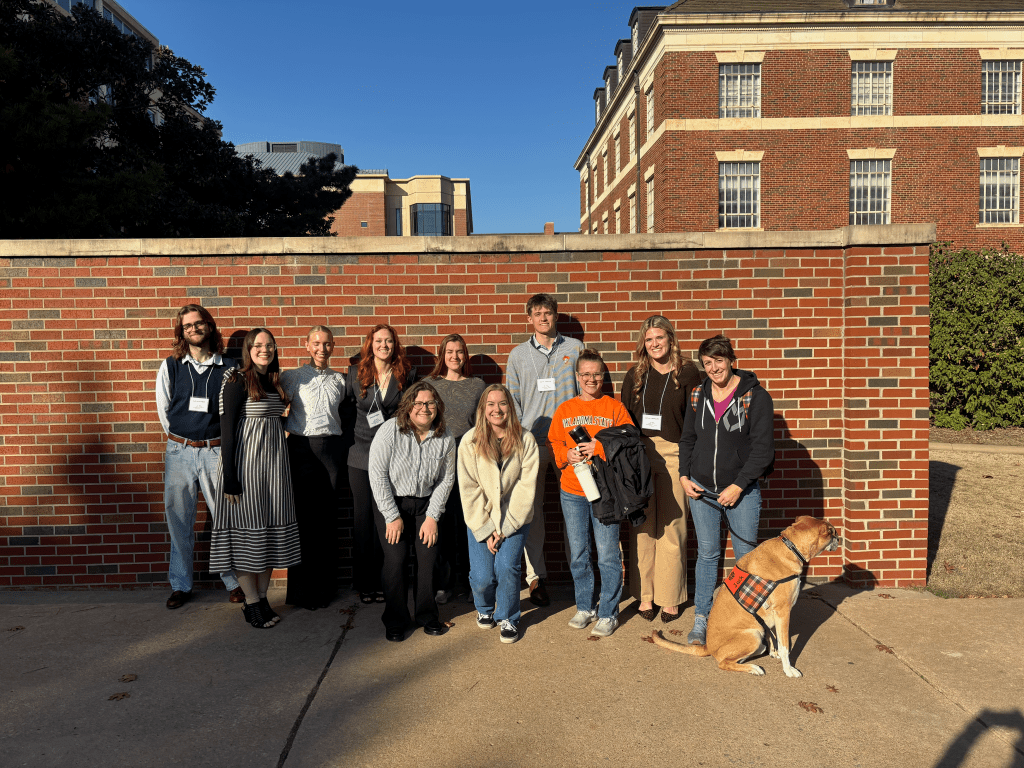
2025!?!

Call to Action

Our lab, like many in the U.S., has been impacted by changes to the scientific infrastructure. We had the fortune of good funding success in the past, and recently with highly meritoriously selected grants. Unfortunately we also have had a grant terminated (see Tulsa News6, Stillwater Newspress, and Washington Post coverage). This grant would have funded a final cohort of ten people to be paid full time researchers on OSU campus – they now have to scramble to find other opportunities.

We also have several pending grants that have been delayed or likely will never be funded despite high importance and impact. We had applied for an National Institutes of Health (NIH) ReWARD R01, which is a multi-million dollar grant that would have funded our research for five years, but also connected scientists with advocates, autistics, family members, and clinical caregivers to help bridge communities impacted by autism. However, this mechanism was considered DEI and is likely permanently terminated and will never be funded leaving our funding in forever limbo. We also have two other NIH grants that have been delayed and a delayed potential NSF grant.

What does this mean? This means that we have been scrambling to keep our lab afloat this summer. We have limited funding for graduate students to 1.5 months from 3, we are reducing or eliminating costs, we are unable to pay undergraduates for their summer research time, we are struggling to pay for our animal care costs, we have delayed hiring, we have eliminated PI summer salary funding, and in general we have been stressed out!

What can you do? We are hoping our funding situation will improve in July and August, but for now – if research is valuable to you, and you want to support our lab – you can donate here to help us bridge this gap in funding – no amount is too small and all will help! See below to check out what we have been up to and what types of things your donation would help fund.

Thank you for the support!!

What have we been up to?

Graduations – we have had lots of amazing undergrads come through the lab since it started in 2020. This year we are graduating a few and we are so excited to see what they decide to do with their futures!

Preston Freeman joined the lab 2023 working with Clare Barr (fellow undergrad) on a project that was started by former undergrad Ishani Ray. Preston has been working to understand if mice with a genetic form of autism, called Fragile X Syndrome, have the same number of cells in the brain representing sounds as neurotypical mice. This is not an easy project, but Preston has been an amazing contributor in the lab and we are looking forward to seeing what he does next!

Jorja Ford joined the lab in 2023 and quickly found herself working on several different projects. She instantly took to working with Jesse on her prairie vole projects, but then it was clear that Jorja was ready for some more independence. At the same time as Jorja was ready for her own project, we started a collaboration with Dr. Ed Lucas in nutrition to examine that effects of pinto beans on Alzheimers-like phenotypes. Jorja was also awarded a Niblack scholarship to help her dedicate her time to work on this research. Jorja has been awesomely productive and presented her work last summer in the annual Nutrition conference in Chicago. We are hoping Jorja is going to find the perfect research-based opportunity for her next steps soon.

Rodney Ashaba joined the lab in Fall 2024 while taking my Principles of Neuroscience course. He has spent the last few months exploring the different projects in the lab and providing great feedback during lab meetings. This summer he will continue in the lab and help transition into Preston’s project.

Roland Ngom joined the lab in Fall 2024 also due to my Principles of Neuroscience class. He quickly excelled in taking on his own project and is currently working through the summer to establish a mouse line in the lab that allows for selective highlighting of specific auditory cell in the brain.

Morgan Scott joined the lab in Fall 2024 as a part of the Principles of Neuroscience cohort like Roland and Rodney above. She has been working with Lu to examine differences in neural circuits in the brain across the wild rodent species he collects in the field.

Eden Rutledge joined the lab for a short project in the Fall of 2024 to complete her Honors thesis graduating in December 2024. She focused on whether different startling sounds, like ambulance sirens – which is super relevant for her since she is an EMT – make mice more or less responsive.

ON-RaMP – we had the pleasure of finishing out our second cohort of the National Science Foundation (NSF) funded RaMP program here at OSU in 2024-2025. This year we got to include the amazing Naleyshka (Nale) Colon-Rivera into the lab. She had lots of different projects, from braving the Oklahoma and Kansas wilderness with Lu to collect wild rodents to understand hearing across species (which will hopefully be coming out in publication on the hispid pocket mouse in the next few months) to working with our autistic Fragile X Syndrome mice. She presented the capstone of her project at the final ON-RaMP symposium along with the nine other postbacs who spent time in OSU labs this past year (see picture). We were just about to welcome our last cohort of ten graduates to spend a paid year in the lab gaining research skills when our grant was abruptly canceled. This is a real travesty for American science and ends an awesome program that had a great impact across the years we were active.

Science Outreach – One of the passions of the lab is to share our science with the general public. To this end:

  • Liz got to go on a podcast “The Odd Fellows” to talk with Dr. Skye Cooley and Dr. Andrew Abernathy to talk about the research in the lab.
  • OSU featured Liz in their monthly “Research on Tap” series at Iron Monk – you can catch the recording here.
  • The Honors Acoustics class was featured on Kicker Unmasked, where we talk about Liz’s research but also what the class got to do in Fall semester – this is a really fun class – highly recommend if you are interested in Acoustics, co-taught by the awesome Aaron Surratt of Kicker.

Awards – The McCullagh lab was honored to receive several awards this year:

  • Sabiha Alam received the Integrative Biology Outstanding PhD Student award
  • Genesis Alarcon received the Integrative Biology Outstanding Masters Student award
  • Andi Gensky received the Wilm Graduate Student Travel Award
  • Amita Chawla received the Wilm Graduate Student Travel Award
  • Olivia Emerson received the Niblack scholarship and Lyle Family Scholarship
  • Grant Emerson received 2nd place in the Spring Karen Smith Symposium poster presentation and the Dr. G Michael Steelman Endowed Scholarship
  • Eden Rutledge won 3rd place in the Fall Karen Smith Symposium
  • Liz McCullagh received the College of Arts & Sciences Early Career Faculty Award for Scholarly Excellence and the Excellence in Research Mentoring Award

Miscellaneous – we had lots of other fun comings and goings this year:

  • Liz and collaborator Giulia Bertolin, through their FACE Foundation funding, published a paper showing sex-specific differences in mitochondria (the powerhouse of the cell!) in our FXS mice. Check it out in Open Biology here.
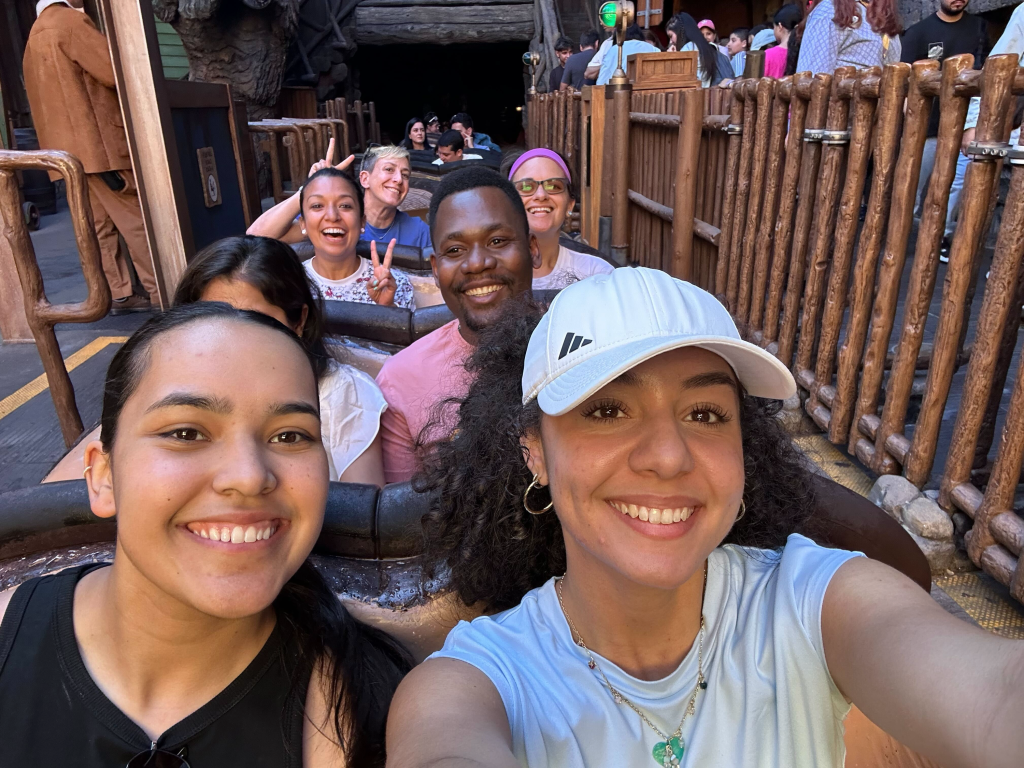
  • A bunch of the lab (see photos above) traveled to the Association for Research in Otolaryngology (ARO) annual conference in Orlando, FL where we presented our research in both contributed talks (Luberson Joseph and Amita Chawla) and poster sessions (Genesis Alarcon, Andi Gensky, and Nale Colon-Rivera (her first poster ever!)). We also had some fun traveling to Disney World Magic Kingdom – thanks Crystall Aeppli Samano and Wendy Aeppli Samano for showing us around and getting us discounts!
  • Liz gave a talk at both the winter Animal Behavior Conference in Steamboat Springs, Colorado and a panel at the Winter Conference on Brain Research, with Sabiha Alam presenting a poster in Tahoe, California.
  • Undergrads have been presenting a ton on campus! In the winter Karen Smith Symposium we had 9 of 15 presenters from the McCullagh lab including Addison Browning, Anastacia Simmons, Julie Luper, Agustin Delgado, Ashlee Munoz, Grant Emerson, Olivia Emerson, Preston Freeman, and Eden Rutledge, In the Spring Karen Smith Symposium we had 12 of 32 presenters from the McCullagh lab with presentations from Grant Emerson, Olivia Emerson, Preston Freeman, Emillia Hubbard, Gracie Toben, Caden Miller, Ashlee Munoz, Agustin Delgado, Roland Ngom, Anastacia Simmons, Addison Browning, and Julie Luper. Grant Emerson also presented his work at the Wentz Symposium, Sydney Cuttler and Laci Wright presented at the Freshman Research Scholar Symposium, and Olivia Emerson, Jorja Ford, Addison Browning, Anastacia Simmons, and Julie Luper presented at the Undergraduate Research Symposium.

What’s Next? Hopefully funding will come through sooner rather than later so that we continue our important research! We also have several events and exciting things happening this summer.

  • Casey Sergott and Jesse Hurd are traveling to Baltimore to give talks at the Annual Animal Behavior Conference in July.
  • We are being joined this summer by Tayres Bluett as a part of the SUREIA program through the Acoustical Society of America (ASA) to gain some experience in the lab in acoustics – welcome Tayres, we are excited to have you!
  • We have several other papers in the works that we hope will come out soon – you can check out the preprints in the meantime here: